


Understanding Basic Blackjack Strategy Options
To win at blackjack, you must first master the fundamental elements of the game. Before exploring advanced tactics, it's crucial to have a firm grasp of your options. The basic blackjack strategy is nearly universal across all game variations, making it an essential skill for any player.
Here are the core decisions you'll make at the blackjack table:
- Hitting/Standing: Hitting means you request another card. Standing means you are satisfied with your current total and want no more cards. You will make one of these two decisions in almost every hand.
- Splitting: If you are dealt a pair of equally valued cards, you can split them into two separate hands. This requires a second bet equal to your first, and you play each hand independently.
- Doubling Down: This move allows you to double your initial bet in exchange for receiving only one additional card. It's a powerful play, typically best used when your first two cards total 10 or 11.
- Surrendering: Some blackjack versions allow you to surrender your hand after the initial deal, forfeiting half your bet. This is a defensive move used when you have a very poor hand against a strong dealer upcard.
How the House Edge Impacts Your Strategy
When you perfectly apply a basic blackjack strategy, the house edge can be as low as 0.5%. This means for every $100 you bet, you can expect to lose only 50 cents over the long term. However, this edge can change based on specific table rules:
- Number of Decks: Fewer decks generally lower the house edge.
- Dealer Rules: Whether the dealer hits or stands on a soft 17 affects the odds.
- Surrender Option: The availability of surrender slightly reduces the house advantage.
Even with these variations, sticking to a perfect strategy ensures you minimize your losses and maximize your winning potential over time.
What is a Blackjack Strategy Chart?
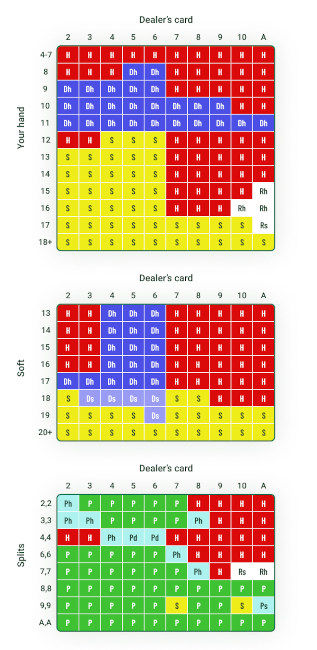
A blackjack chart is a grid that tells you the mathematically correct move for any combination of your hand and the dealer's upcard. It simplifies your decisions by removing guesswork and emotion from the equation.
These charts are completely legal to use in casinos. They don't guarantee a win on every hand, but they serve to increase your overall chances by helping you make the optimal play.
The chart's advice is based on probability, guiding you to the decision that is most likely to result in a win or minimize a loss. Remember, the house always has a slight edge, so a perfect strategy is about making the best possible decision in every scenario.

How to Use a Blackjack Chart Effectively
Using a strategy card can seem intimidating at first, but it's a straightforward process. Here’s a step-by-step guide to using this powerful tool.
1. Select the Correct Chart
Charts vary based on table rules. The two most important factors are:
- The Number of Decks in play.
- The Dealer's Soft 17 Rule (whether they hit or stand).
This information is usually printed on the table felt. If you're unsure, just ask the dealer.
2. Find Your Hand on the Chart
Your hand is located on the vertical axis (the left side) of the chart. Most charts are divided into three sections: hard totals, soft totals, and pairs.
3. Find the Dealer's Upcard
The dealer's visible card is located on the horizontal axis (the top) of the chart. Find the column that corresponds to the dealer's card.
4. Make the Indicated Play
The correct play is found at the intersection of your hand's row and the dealer's upcard column. The chart uses abbreviations like H (Hit), S (Stand), D (Double), and P (Split) to indicate the optimal move.
Memorizing Key Blackjack Strategies
While a chart is helpful, memorizing the core principles will make you a faster and more confident player. Here are the key rules for different hand types.
Playing Hard Hands (No Ace)
- Hard 17+ : Always stand.
- Hard 13-16: Stand if the dealer shows 2-6. Hit if the dealer shows 7 or higher.
- Hard 12: Stand if the dealer shows 4-6. Otherwise, hit.
- Hard 11: Always double down.
- Hard 10: Double down if the dealer shows 2-9. Otherwise, hit.
- Hard 9: Double down if the dealer shows 3-6. Otherwise, hit.
- Hard 8 or less: Always hit.
Playing Soft Hands (With an Ace)
- Soft 19 (A,8) or higher: Always stand.
- Soft 18 (A,7): Stand against a dealer's 2-8. Hit against 9, 10, or Ace. Double down against 2-6 if the rules permit.
- Soft 17 (A,6): Double down against dealer's 3-6. Otherwise, hit.
- Soft 13-16: Double down against dealer's 4-6 (or 5-6). Otherwise, hit.
When to Split Pairs
- Aces and 8s: Always split.
- 10s and 5s: Never split. A pair of 10s is a strong 20, and a pair of 5s is a hard 10, which is great for doubling.
- 9s: Split against a dealer's 2-9 (except 7). Otherwise, stand.
- Other Pairs (2s, 3s, 6s, 7s): Generally, split against a weak dealer upcard (2-7).
Start Practicing and Win More Often
The basic blackjack strategy outlined here provides a complete foundation for new and casual players. Before playing for real money, take the time to understand and memorize these rules. Once you've mastered the basics, you can explore more advanced strategies tailored to specific game variations.
By playing with a solid strategy, choosing the right game, and always playing responsibly, you give yourself the best possible chance to succeed at the blackjack table.


