
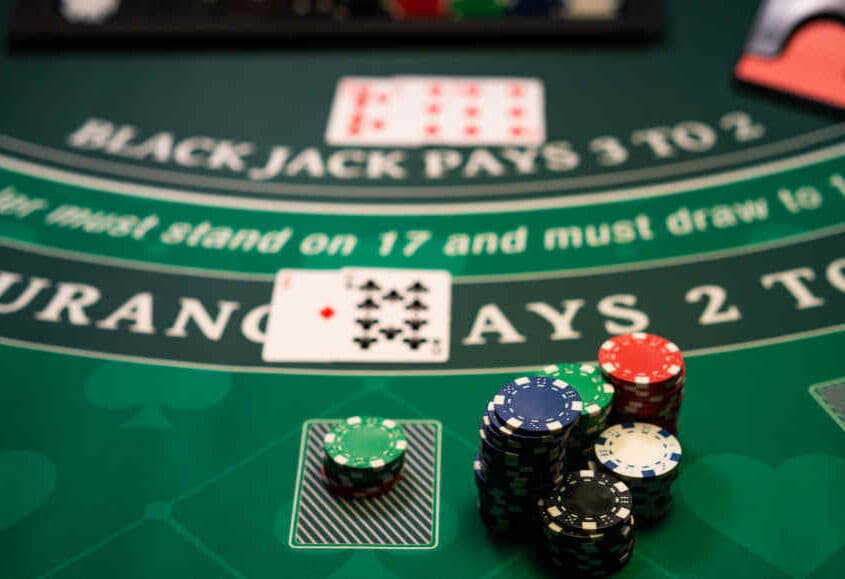


What Does it Mean to Stand in Blackjack?
When you decide to stand in blackjack, you are signaling to the dealer that you are happy with the total value of your cards. You won't receive any more cards for that round, and your turn is over. The action then moves to the next player or, if you are the last player, directly to the dealer who will then play out their hand. This decision is also known as 'sticking' or 'staying' in some variations of the game, particularly outside of North America.
The choice to stand is fundamental. It's a strategic decision based on your hand's value and the dealer's visible upcard. The main goal is to get a hand total closer to 21 than the dealer's, without going over. Standing is your way of locking in your total and hoping it's strong enough to win.
The Goal of Standing: Avoiding the Bust
The primary reason to stand is to avoid busting. A 'bust' happens when your hand total exceeds 21, resulting in an immediate loss of your bet for that round. If your hand total is high, such as 17 or more, the risk of taking another card and busting is very high. In these scenarios, standing is almost always the correct strategic play. By standing, you preserve your hand and shift the pressure onto the dealer, who must play by a fixed set of rules and may be forced to hit and potentially bust themselves.
How to Signal 'Stand' to the Dealer
In a live casino setting, clear communication is essential. While you can verbally say "stand" or "stay," all casinos require players to use hand signals for the benefit of security cameras. The universal stand hand signal in blackjack is to wave your flat hand horizontally over your cards. It’s a simple, clear gesture that looks like you're waving 'no' to another card. This non-verbal cue prevents any misunderstandings between you and the dealer.
When to Stand in Blackjack: Basic Strategy
Knowing when to stand in blackjack is the cornerstone of a winning approach. Basic strategy, derived from millions of computer-simulated hands, provides a mathematically optimal way to play every hand. Here’s a simplified breakdown of the rules for standing.
The art of blackjack isn't just about getting close to 21; it's about knowing when the risk of busting outweighs the potential reward of hitting. Standing is the ultimate defensive move that protects your hand and puts the dealer on the defensive.
Standing on Hard Totals
A 'hard total' is any hand that does not contain an Ace, or a hand where the Ace must be counted as 1 to avoid busting. The rules are quite clear:
- Always Stand on Hard 17 or Higher: With a hand totaling 17 to 21, your chances of improving without busting are extremely low. This is a solid standing hand.
- Stand on Hard 13-16 vs. a Dealer's 2-6: When the dealer shows a weak upcard (2 through 6), they are more likely to bust. In this case, you don't need to risk improving your own hand. Standing on your mediocre total is the correct play, as you are betting on the dealer going over 21.
- Stand on Hard 12 vs. a Dealer's 4-6: This is a trickier hand, but basic strategy dictates you should stand if the dealer shows a 4, 5, or 6. Hitting a 12 is risky, as any card 10 or higher will cause you to bust.
Standing on Soft Totals
A 'soft total' is a hand that includes an Ace counted as 11. These hands are more flexible because you can take a hit without the risk of busting (the Ace would simply convert from 11 to 1).
- Always Stand on Soft 19 (Ace, 8) or Higher: A total of 19 or 20 is a very strong hand. There is no strategic reason to risk taking another card.
- Stand on Soft 18 vs. a Dealer's 2, 7, or 8: This is a more complex situation. While many players might hit, the optimal strategy in many rule variations is to stand, as your 18 is a decent total against these specific dealer cards.
Stand vs. Hit: The Core Decision
Every round of blackjack revolves around the decision to blackjack stand or hit. Hitting offers the potential to improve your hand but carries the risk of busting. Standing is the safe option that locks in your total. The best players understand this balance and use basic strategy to make the right choice every single time, minimizing the house edge and maximizing their chances of success.


